
|
|
ECE4253 Digital Communications |
| Department of Electrical and Computer Engineering - University of New Brunswick, Fredericton, NB, Canada | |
This online tool draws and analyzes digital circuits which generate Linear Recursive Sequences (LRS) based on a defining polynomial P(x). The circuit shown below is traced through all possible states. Maximum length sequences are identified. The autocorrelation of each sequence can also be checked (maximum 1023 bits).
 alternate configuration

Circuit based on P(x) = x4+x3+x2+x+1
| Sequence #1 (Starting with 0) |
| States: 0 0 forever... |
| Sequence #2 (Starting with 1) |
| States: 1 8 12 6 3 1 |
| Period = 5 (autocorrelation)
Output = 10001... |
| Sequence #3 (Starting with 2) |
| States: 2 9 4 10 5 2 |
| Period = 5 (autocorrelation)
Output = 01001... |
| Sequence #4 (Starting with 7) |
| States: 7 11 13 14 15 7 |
| Period = 5 (autocorrelation)
Output = 11101... |
| Modulo 2 addition is shown schematically equivalent to Exclusive-OR gates. | 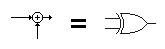
|
|
2025-06-18 01:31:25 ADT
Last Updated: 2014-01-13 |
Richard Tervo [ tervo@unb.ca ] | Back to the course homepage... |